A Streak Ends on the Ramp in Brescia: The 2026 Mille Miglia
Juan and Margarita Tonconogy's fourth victory came the hard way, against the most dominant crew in the modern history of the race. Why the Red Arrow still matters, and why winning it is harder than it looks.
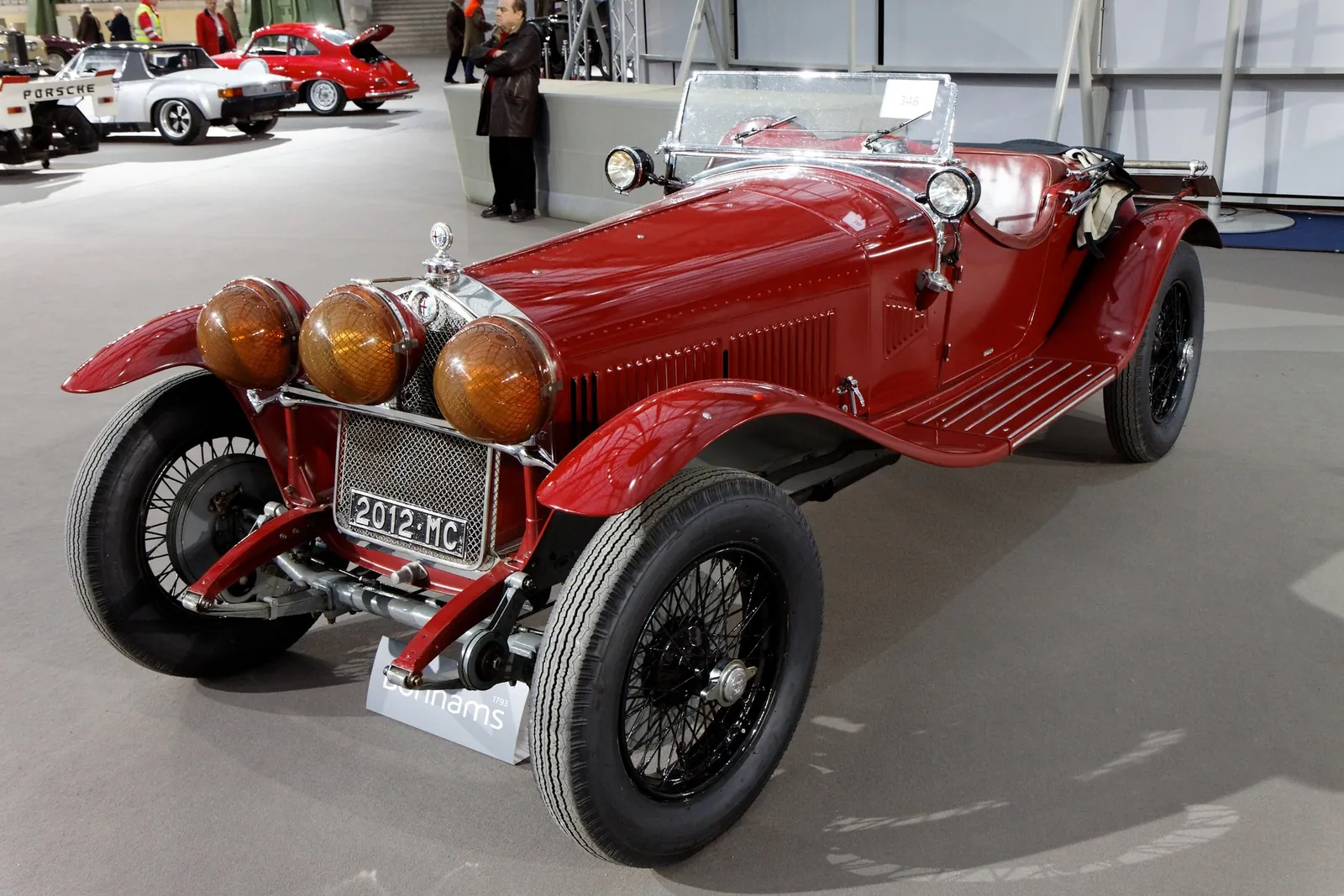
The 2026 Mille Miglia, run June 9 to 13 over five legs and nearly 2,000 kilometers of Italian roads, ended the most extraordinary winning streak in the modern history of the event. Juan and Margarita Tonconogy, the Argentine siblings, won in their 1931 Alfa Romeo 6C 1750 GS Spider Zagato, defeating Andrea Vesco and Fabio Salvinelli, who had won the previous six editions consecutively, from 2020 to 2025. It is Juan Tonconogy's fourth personal victory in the Red Arrow, after 2013, 2016 and 2018, but his first alongside his sister.
The Mille Miglia rewards a specific, almost unglamorous skill, the ability to hold a 1930s car at an exact average on public roads, repeated hundreds of times over five days, and it rewards it ruthlessly.
Second place went to Vesco and Salvinelli in their 1929 Alfa Romeo 6C 1750 SS Spider Zagato. Third went to Lorenzo and Mario Turelli in a 1929 O.M. 665 S MM Superba. The Coppa delle Dame went, as it so often does, to Silvia Marini, this year with Francesca Ruggeri in a 1947 Cisitalia 202 S MM Spider. In the supporting events, Vittorino Battaglia and Giordano Mozzi won the Ferrari Tribute in a 2019 488 Spider, and Ryotaro Shimizu and Jari-Matti Latvala took the Gran Turismo Experience.
A route built like a figure of eight
The 2026 edition ran a demanding figure-of-eight route through Padua, Montecatini Terme, Rome and Rimini before returning to Brescia and the historic ramp on Viale Venezia. The competitive format is regularity, not outright speed: 144 time trials and 8 average trials, where the winners are the crew that most precisely matches prescribed average speeds over measured sections. This is why the same names keep winning. The Mille Miglia rewards a specific, almost unglamorous skill, the ability to hold a 1930s car at an exact average on public roads, repeated hundreds of times over five days, and it rewards it ruthlessly.
Eligibility is strict, which is part of the event's authority. Only models built between 1927 and 1957 that actually took part in the historic Mille Miglia may enter, and every car must be certified in advance by the Registro 1000 Miglia, the body that attests to each car's authenticity. More than 450 cars started this year. The entry list included familiar faces from well beyond historic racing: former Formula 1 driver Giancarlo Fisichella in a 1954 S.I.A.T.A 30 BC, motorcycle champion Loris Capirossi in a 1949 Lancia Aprilia, and chef Carlo Cracco, now a regular, in a 1951 Lancia Aurelia B20.
Why the Tonconogy win matters
Vesco had not merely been winning. He had turned the modern Mille Miglia into a demonstration, six consecutive victories in a discipline where a single mistimed trial can cost the race. The 2026 battle was, by the official account, decided on precision under pressure in the final trials, with the Tonconogys defending a narrow lead against sustained attack. Beating Vesco at regularity rallying is comparable to beating a champion time-trialist at his own event: it does not happen by luck.
There is also a symmetry in the machinery. Both leading crews were in pre-war Alfa Romeo 6C 1750s with Zagato coachwork, cars of the type that made the Mille Miglia's reputation in the first place. The original race, run from 1927 to 1957, was Alfa Romeo's proving ground before it became anyone else's, and the marque's association with the Red Arrow is the deepest in the sport. The Turellis' third-place O.M., another Brescia-built machine, only strengthens the sense that this year's podium belonged to the race's own history.
The event that refuses to become a parade
The Mille Miglia has been a regularity rally rather than a flat-out race since its revival, and that is precisely why it has survived while other revived events have become costume parades. The competitive element is real enough that crews prepare all year, the cars are used as cars, and the timing is measured in hundredths. It is also one of the few major motoring events where the spectators are not confined to grandstands but stand on the roads of a thousand Italian towns, which is where the race's claim to be the most beautiful in the world comes from. It is not marketing copy. It is geography.
The original Mille Miglia was stopped after 1957, when the romance of flat-out racing on public roads collided with its human cost. The modern event keeps the route, the cars, and the crowds, and replaces the danger with discipline. Juan Tonconogy's fourth victory, and the end of Vesco's reign, will be remembered as the year the Red Arrow proved it can still produce a genuine contest. That is the only thing that keeps a historic event alive: the possibility that the expected thing does not happen.