Toyota's Patience, Rewarded: The 2026 24 Hours of Le Mans
After three years of Ferrari and a qualifying collapse, the number 7 Toyota won the 94th running of the endurance classic by 11 seconds. What a close finish reveals about modern endurance racing.
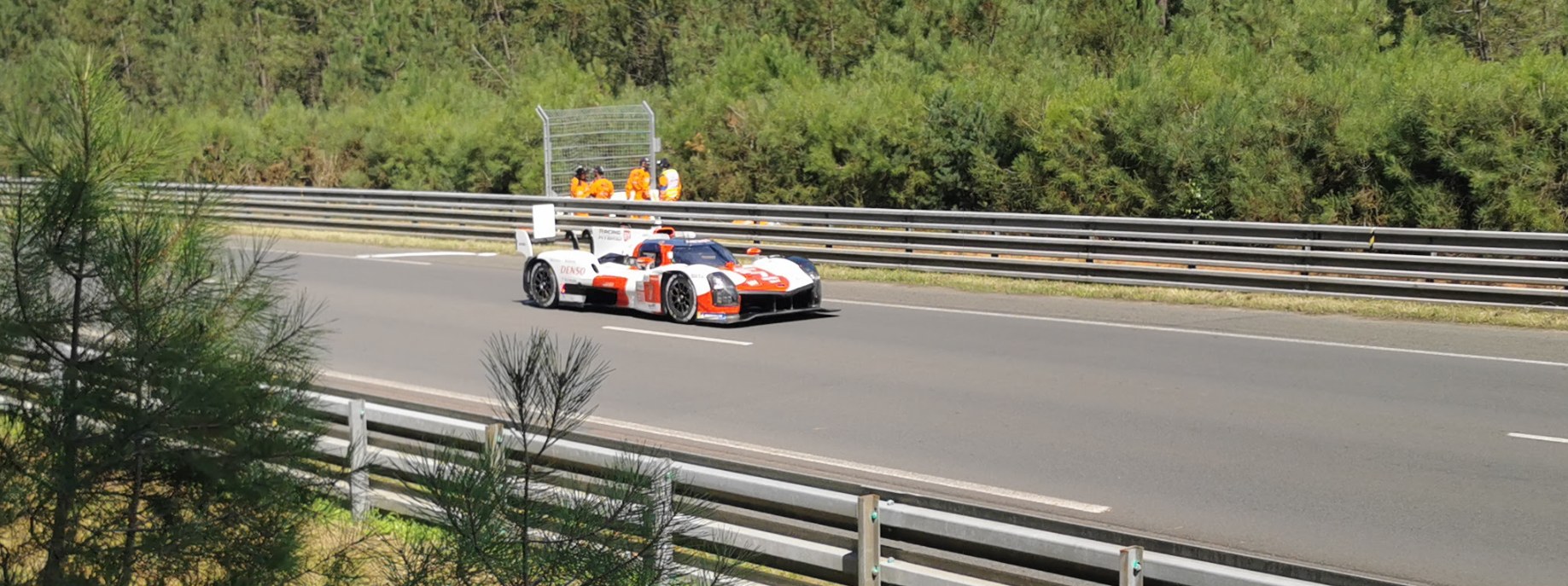
The 94th 24 Hours of Le Mans, run June 13 and 14 on the Circuit de la Sarthe, will be remembered for a margin and a comeback. The number 7 Toyota GR010 Hybrid, driven by Mike Conway, Kamui Kobayashi and Nyck de Vries, won by 11 seconds over the number 20 BMW M Hybrid V8 of Robin Frijns, Sheldon van der Linde and Rene Rast, after 24 hours of racing. Toyota's number 8 car completed the podium. Seven cars finished on the lead lap.
Not a sprint and not a parade, but a long exercise in not making the mistake that loses it.
The margin only tells half the story. On Thursday evening, both Toyotas had qualified 14th and 15th in Hyperpole, effectively nowhere. The number 7 started 14th. The winning move was not speed but a strategy run with unusual discipline: an offset fuel plan in the opening hours, clean driving through the night, and a safety car in hour 19 that compressed the leading group and turned the race into a sprint. When the final round of pit stops cycled through, Kobayashi had a 21-second advantage. Frijns chipped it away over the final hour but never closed it.
The end of a streak
Ferrari arrived at Le Mans having won the previous three editions. It left with the number 51 car in fifth. That, more than any single overtake, is the result that will matter to the championship, and it is the kind of reversal that defines this era of the Hypercar class. The field is now so deep that three consecutive wins look, in retrospect, like a near impossibility rather than a baseline. Genesis Magma Racing, Hyundai's luxury division, made its Le Mans debut as the first South Korean manufacturer team in the top class, and Porsche, which withdrew from the WEC Hypercar class for 2026, was conspicuous by its absence.
Pole had belonged to Dries Vanthoor's BMW, and for long stretches the race looked like BMW's to lose. The number 15 BMW, started from the front by Kevin Magnussen, retired in the final hour with mechanical trouble after a long garage stay. The number 12 Jota Cadillac of Will Stevens ran at the front deep into the race and finished fourth, eleven point nine seconds off the podium. The number 38 Cadillac, with Sebastien Bourdais and Jack Aitken aboard, was running strongly until a power steering problem sent it down the order and eventually out.
The other classes
In LMP2, Inter Europol Competition took a one-two finish, the number 43 Oreca 07 of Tom Dillmann, Jakub Smiechowski and Nick Yelloly leading the team's third victory in four years. In LMGT3, TF Sport's number 33 Chevrolet Corvette Z06 GT3.R of Nicky Catsburg, Jonny Edgar and Ben Keating won, the tenth class victory for the Corvette name at Le Mans. Sixty-two cars and 186 drivers started the race, flagged away by Tour de France sprint great Mark Cavendish.
What 2026 proved
Endurance racing has a way of humbling every theory about it, and this year's race humbled two. The first is that qualifying matters in Hypercar. It does not, or at least not this year, and not to Toyota, which spent the first quarter of the race recovering from a bad Thursday and then simply out-executed everyone on pit wall discipline and stint management. The second is that the manufacturer's advantage is permanent. Toyota had not won Le Mans since 2022. Four years is an eternity in this sport's development cycle, and the GR010 that won in 2026 is a different proposition from the car that won in 2022, running against a field that includes BMW, Cadillac, Ferrari and now Genesis at full commitment.
For de Vries, the win was a first at Le Mans. For Kobayashi and Conway, it was a second. Kobayashi drove the final stints, which is where this race is always decided, in the last two hours when the gap, the tires, and the fuel all have to be managed at once. The final hour, with Frijns closing and Kobayashi nursing the car home, was the purest expression of what the 24 Hours has always been: not a sprint and not a parade, but a long exercise in not making the mistake that loses it. Toyota, this year, did not make it.