Zurich and Nashville: The Week the Modern Hypercar Took the Auction Room
A Veyron at CHF 4,505,000 in Zurich and a $73 million debut in Nashville point the same way: the modern limited-run hypercar now commands the auction room's top lines. Read the prices precisely, though, because the catalogues tell a more selective story than the headlines.
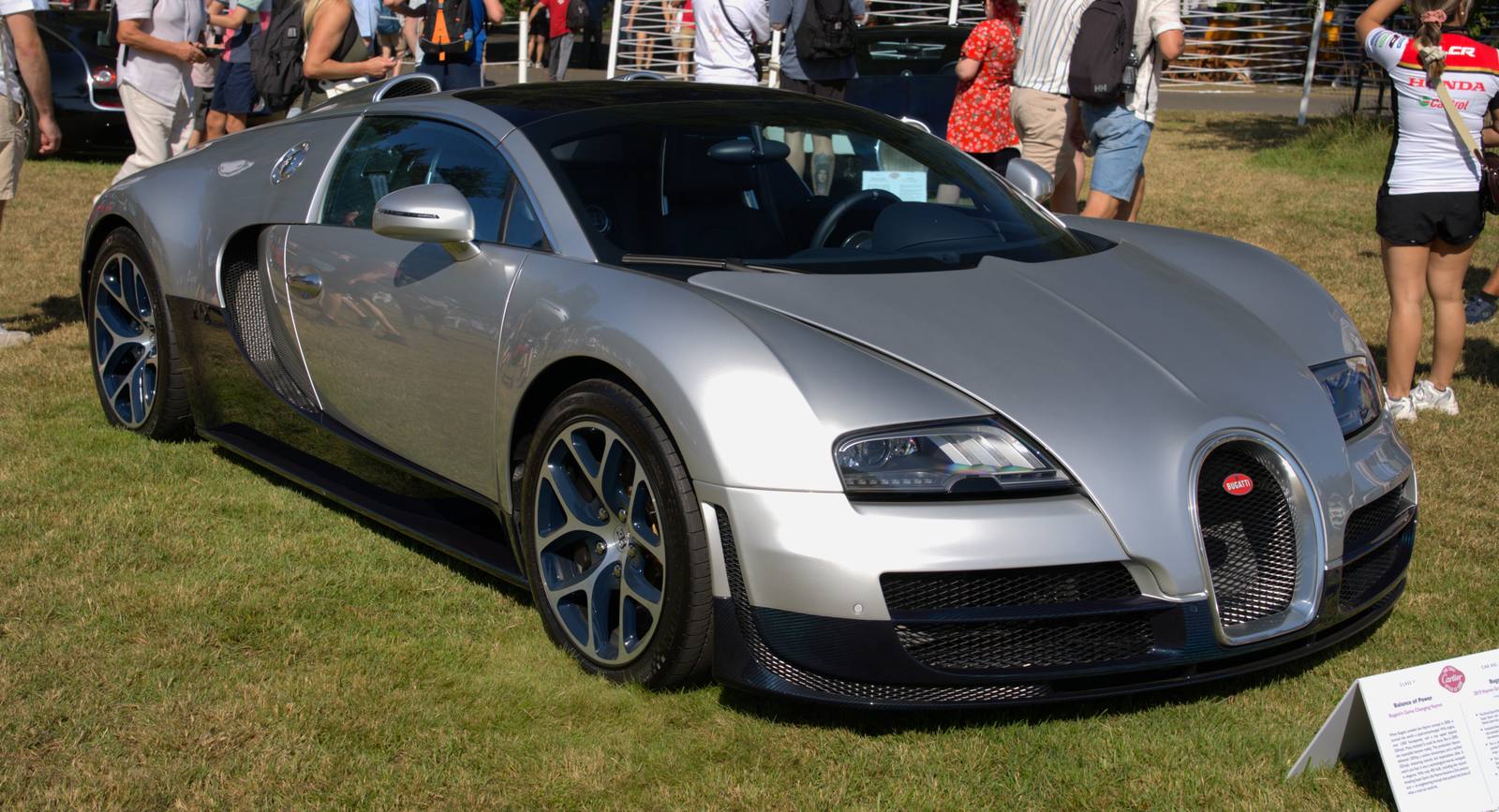
Two auctions, one weekend, one signal. On 26 September, RM Sotheby's Zurich sold a 2014 Bugatti Veyron 16.4 Grand Sport Vitesse "Jean-Pierre Wimille" for CHF 4,505,000, about $5.44 million, a public-auction record for the Veyron. Days earlier, Mecum's first Nashville auction, held 22 to 26 September at Nashville Superspeedway, generated more than $73 million in sales at a 75 percent sell-through rate, the most successful inaugural auction in company history. Different rooms, different continents, the same direction of travel: the modern limited-run hypercar now commands the top lines.
A market that will pay CHF 4.5 million for the right Veyron will still pass a Huayra Roadster and an AMG One at the wrong number. That is not weakness; it is discrimination.
The Veyron, precisely
The published result was CHF 4,505,000 against a pre-sale estimate of CHF 2.4 to 2.8 million, roughly 61 percent above the top of the range. It eclipsed the previous public-auction record for the model, a one-off Veyron Grand Sport Sang Bleu sold in 2024 at roughly $3.09 million. The record car is one of just three "Jean-Pierre Wimille" examples, the first of Bugatti's six-car Les Légendes de Bugatti series. Chassis 795063 pairs Bleu Wimille paint with dark blue exposed carbon fibre, a scheme drawn from the Type 57G Tank that Wimille shared with Robert Benoist to win Le Mans in 1937; Wimille won the race for Bugatti again in 1939. References continue inside: his signature embroidered into the headrests and engraved on the filler caps, the Circuit de la Sarthe layout beneath the rear wing and in the cabin, French tricolore stitching. The odometer showed 3,766 km.
That a second Wimille example sold for about $2.64 million in 2022 puts the curve in context: the 2026 price roughly doubled the 2022 level in four years. Appreciation is steepening, not flattening.
Zurich also supplied the counter-signal. The sale published CHF 16.3 million in results with 17 of 23 cars sold, but six went unsold, including two of the catalogue's biggest modern machines: a Pagani Huayra Roadster and a Mercedes-AMG One, alongside a Ford GT Carbon Series and a Porsche 911 R. Records at the top, caution in the middle.
Nashville, precisely
Mecum's debut at Nashville Superspeedway, the only auction on its schedule held at a racetrack, expanded to five days on consignment demand and put 1,750 vehicles across the block. The published top ten tells the American story: a 2024 Ferrari 812 Competizione Aperta at $4,050,000, sold after the auction through Mecum's Bid Goes On department; the 1995 Ford Mustang Cobra "Nobody's Fool" IMSA road racer, driven by Paul Newman, at $935,000; the 1997 Ford Mustang Cobra SCCA Trans-Am car driven by Tommy Kendall at $825,000; a 2020 Ford GT Mk II at $792,000; a 2005 Ford GT with 70 miles at $770,000; a 2006 Ford GT at $737,000; a 1972 Chevrolet K5 Blazer custom at $693,000; a 1969 Ford Mustang Boss 429 at $616,000; and a 1965 Aston Martin DB5 at $605,000. Both headline Mustangs came from the Jack Roush Automotive Collection.
These are Mecum's published sale prices as reported. A Bid Goes On transaction is a negotiated post-auction sale, not a hammer price, and the distinction matters when comparing records.
The analysis: healthy, but selective
What the two sales share is a buyer profile, not a geography. Provenance, rarity and mileage discipline are doing the work: a 3,766 km one-of-three Veyron, a 70-mile Ford GT, a Newman-driven race car. The modern hypercar has absorbed the premium slot the classic market used to hold unchallenged, and the 812 Competizione Aperta leading Nashville shows the trade no longer distinguishes much between a 1965 DB5 and a 2024 Ferrari when both are scarce and storied.
The unsold lots are the necessary footnote. A market that will pay CHF 4.5 million for the right Veyron will still pass a Huayra Roadster and an AMG One at the wrong number. That is not weakness; it is discrimination. The auction market of late September 2026 is healthy precisely because it is selective. Headline records and passed lots are the same market thinking out loud.