The Electric Turbo, Perfected: Inside the 911 Turbo S T-Hybrid
Two electric turbochargers, a 3.6-litre flat-six and 701 hp. The new 911 Turbo S laps the Nurburgring 14 seconds faster than its predecessor, and turbo lag is officially history.
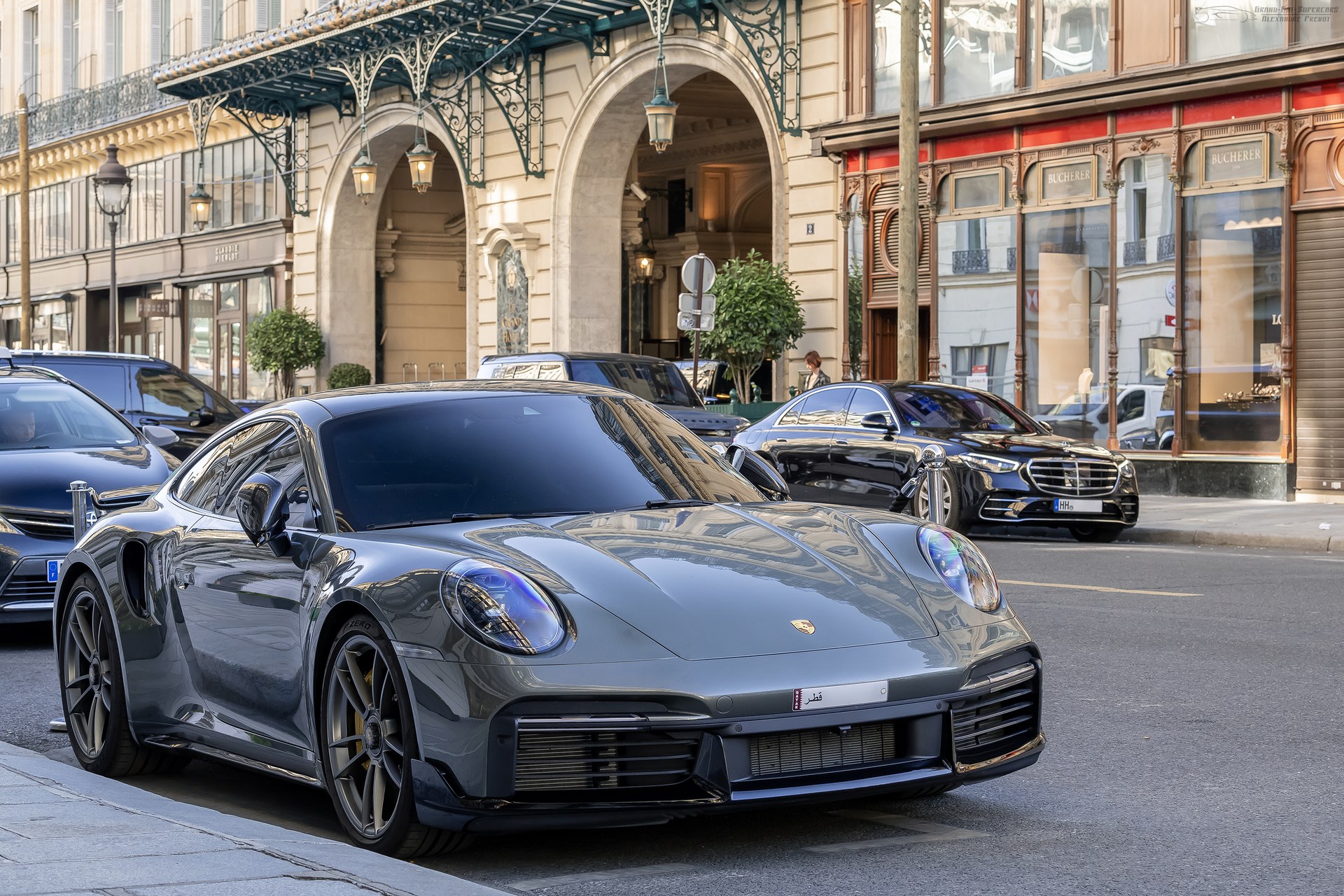
The 911 Turbo has always been the thinking person's supercar: all-weather, everyday-usable, devastatingly fast. The 992.2-generation Turbo S keeps the brief and rewrites the powertrain. The old 3.7-litre engine is gone, replaced by a new 3.6-litre flat-six paired with Porsche's T-Hybrid system. Two electric exhaust-gas turbochargers spool instantly, an electric motor sits inside the eight-speed PDK, and a 1.9 kWh battery on a 400-volt architecture ties it together. System output is 701 hp (711 PS) with 590 lb-ft (800 Nm) of torque.
A self-charging hybrid with no plug and no EV mode theatre, just electricity in service of response.
The eTurbo: lag, eliminated
A conventional turbo waits for exhaust gas. An electric turbo does not have to. Each of the Turbo S's two turbochargers carries an electric motor on its shaft that spins the compressor to speed the instant the driver asks for power, filling the response gap before exhaust energy takes over. The result is throttle response closer to a naturally aspirated engine with the mid-range force of big boost. Porsche quotes 0-60 mph in 2.4 seconds and a 200 mph top track speed.
The Nurburgring number
The headline that will follow this car is 7:03.92. That is the Turbo S's Nurburgring Nordschleife lap time, around 14 seconds quicker than its predecessor. The time comes from the whole package, not just power: the largest carbon-ceramic brakes ever fitted to a Porsche two-door (420 mm front, 410 mm rear), wider 325-section rear tyres, electro-hydraulic roll control on the 400-volt system, and active aerodynamics that trim drag by up to 10 percent in efficient mode.
The analysis: the Turbo grows up again
Every 911 Turbo generation has been accused of becoming too capable, too digital, too easy. Every generation has then embarrassed faster-looking machinery in the real world. The T-Hybrid continues the pattern: a self-charging hybrid with no plug, no EV mode theatre, just electricity in service of response. At $270,300 before options, it remains the do-everything 911. The turbos are now electric. The idea is the same as it was in 1975.


