Aston Martin DBX GT: Power, Quietly
The new DBX GT keeps the DBX S's 717 hp V8 and spends its engineering budget on refinement: recalibrated suspension, acoustic glass, memory-foam seats and an exhaust that knows when to whisper. It is the luxury SUV segment's most eloquent argument that serenity is the new performance.
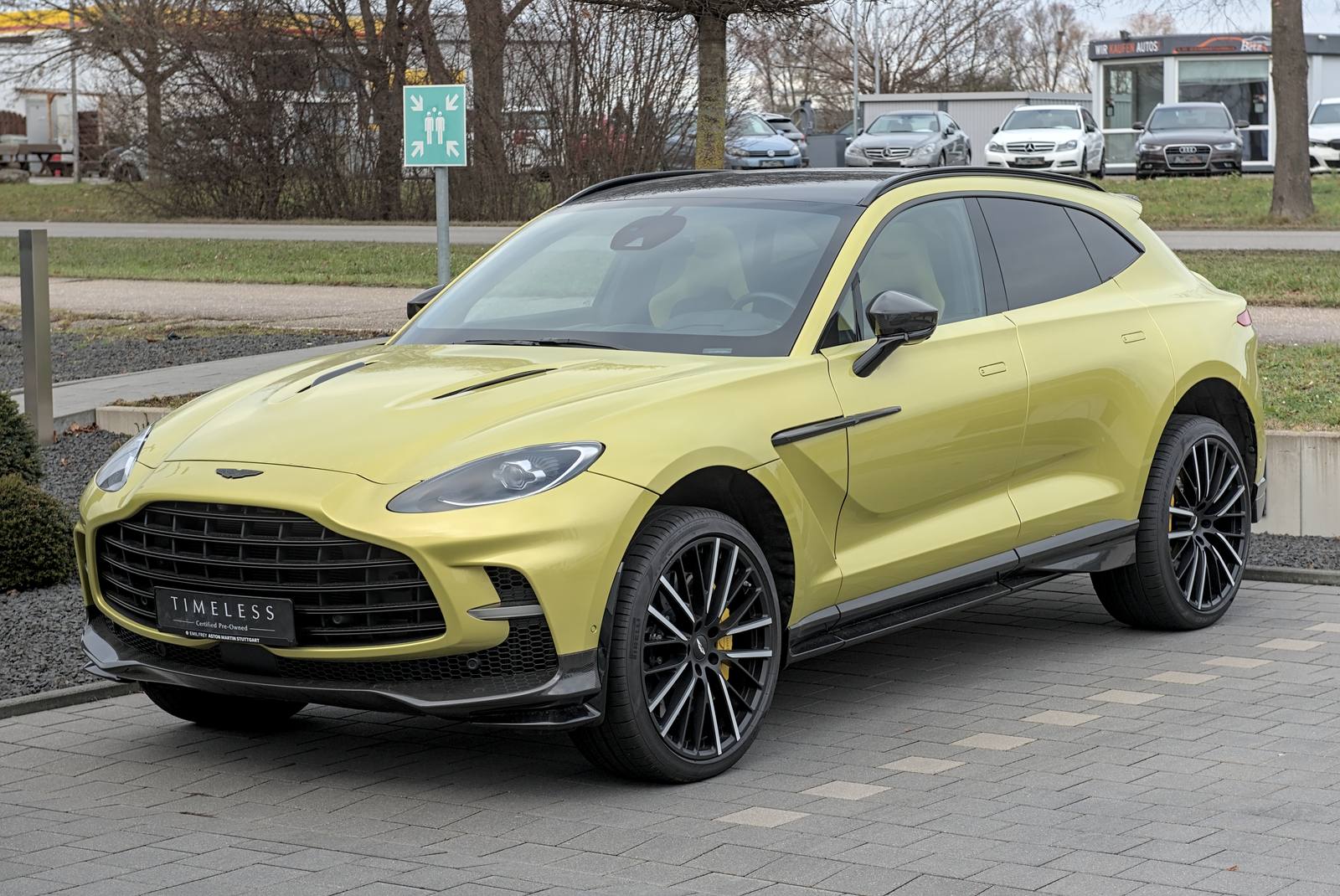
Aston Martin has expanded the DBX range with a new DBX GT, revealed on 1 October 2026. It joins the performance-focused DBX S rather than replacing it, taking the comfort flagship role in the line. The brief is unusually honest for a car launch: keep the S's powertrain and most of its hardware, and spend the engineering budget where owners actually feel it.
Seven hundred horsepower is no longer a differentiator; everyone has it. What buyers cannot get elsewhere is calibration.
The hardware, carried over
Under the bonnet is the same 4.0-litre twin-turbocharged V8 introduced in the DBX S, using turbocharger technology derived from Aston Martin's Valhalla supercar. It produces 717 hp at 6,250 rpm and 900 Nm (664 lb-ft) between 3,000 and 5,250 rpm. The nine-speed automatic has been retuned for smoother shifts and a more progressive throttle response. The GT covers 0-60 mph in 3.1 seconds, 0-100 km/h in 3.3 seconds, and reaches 193 mph (310 km/h). Kerb weight is 2,245 kg, and carbon-ceramic brakes, 420 mm front and 390 mm rear, are carried over from the S.
Standard wheels are 22-inch forged with Pirelli Scorpion Zero all-season tyres, a choice made explicitly for ride comfort and lower road noise; 23-inch wheels remain optional, with summer or all-season tyres.
Where the money went
The GT's suspension is its own: recalibrated adaptive air suspension, new internal damper valves designed to isolate the cabin from small bumps and coarse road surfaces, and retuned transmission mounts. Aston Martin says the chassis actively adjusts spring rate by drive mode, shifting roll stiffness balance through corners to keep steering response while filtering vibration.
Then the acoustic work: additional sound-deadening material, acoustic laminated rear side glass, and deeper carpeting. The measure Aston Martin chose to publish is the Articulation Index, which quantifies how easily occupants can converse while the car is moving: the GT improves it by 13 percent. That may be the most revealing number on the specification sheet.
The seats were redesigned front and rear with extra cushioning, revised bolsters and a 10 mm memory-foam layer. The outer rear seats are individually sculpted, though the five-seat layout stays. A panoramic glass roof is standard, and the exhaust has a dedicated quiet tune in the standard GT driving mode, with Sport and Sport+ restoring the full V8 soundtrack for those who want it.
The design language of restraint
Visually the GT is deliberately understated next to the S. A new double-vane grille, in bright or dark finishes, extends its vanes into the outer vents that house the daytime running lights. Two-piece metal side strakes run along each flank in polished and satin finishes, a detail Aston Martin credits to traditional watchmaking. The lower front bumper, sills and rear diffuser are body-coloured as standard, and the rear gets new quad exhaust finishers arranged in side-by-side pairs to accentuate the car's width.
Inside: semi-aniline leather, deep-pile carpets, GT-specific quilting and embroidery, bespoke monotone, duotone and tritone cabin options, and an anodized metal drive-mode controller. CEO Adrian Hallmark framed it as refinement without sacrifice: "By refining the visual drama and elevating the interior with new elements of craftsmanship, the DBX GT delivers a true ultra-luxury experience; one which comes with no sacrifice in performance" (Magneto).
The analysis: serenity as a specification
The DBX GT is a bet that the ultra-luxury SUV segment has reached a turning point. Seven hundred horsepower is no longer a differentiator; everyone has it. What buyers cannot get elsewhere is calibration: a damper valve tuned for coarse tarmac, a cabin you can hold a conversation in at speed, an exhaust that treats loudness as a mode rather than a personality.
There is also a quiet symmetry at work. The "GT" suffix belongs to grand touring, and the DBX GT is the first DBX to apply touring-car logic properly: long distances, low effort, everything felt but nothing heard. First deliveries begin in the fourth quarter of 2026; pricing is unannounced, though a factory spokesperson told WardsAuto that speculation around $262,000 would be welcome, against the DBX S's roughly $276,500 US starting point. The market will decide whether refinement outranks violence. The GT is Aston's eloquent argument that it should.


