What makes an automobile significant
Speed is the easiest thing to measure and the least interesting thing to ask. Drawing on the Gordon Murray T.50, the Ferrari Amalfi, the Porsche 911 GT3, and the Aston Martin Vanquish, this essay sets out the criteria by which a car earns lasting significance: engineering, design, innovation, craft, rarity, provenance, culture, and the driving experience.
Introduction: the question
Ask a room of enthusiasts what makes a car significant and the first answers will be numbers. Horsepower, acceleration, top speed. They are the easiest attributes to measure, which is precisely why they are the least reliable measure of significance. Numbers are rewritten every model year; the cars that still matter decades later are remembered for something harder to specify.
Numbers are rewritten every model year; the cars that still matter decades later are remembered for something harder to specify.
This essay proposes a set of criteria and tests them against four verifiable reference points from the present market: the Gordon Murray Automotive T.50, the Ferrari Amalfi, the Porsche 911 GT3 in its current 992.2 generation, and the Aston Martin Vanquish. Each is documented by published manufacturer specifications and press reporting. No car here has been driven by ROAD & MOTOR, and no claim in this essay rests on firsthand impression. The question is what can be established on the record, and what the record suggests significance actually consists of.
Engineering: the discipline of the specification sheet
Engineering significance begins with intent made visible in numbers. The T.50's published technical specification is the most instructive document in this essay. The car weighs 986 kg in running order (957 kg dry), against a 3,994 cc naturally aspirated Cosworth V12 producing 663 PS at 11,500 rpm and 467 Nm at 9,000 rpm, with a maximum of 12,100 rpm. The engine itself weighs 178 kg. Power density is 166 PS per litre, and the power-to-weight ratio is 672 PS per tonne. These are GMA's published figures, and their significance lies not in any single value but in their combination: no other current production car pairs a twelve-cylinder engine with a sub-tonne kerb weight.
The Ferrari Amalfi offers a different engineering proposition. Its 3,855 cc twin-turbocharged F154 V8 produces 640 cv at 7,500 rpm with 760 Nm from 3,000 rpm, driving a quoted 1,470 kg dry weight to 100 km/h in 3.3 seconds and on to 320 km/h. The engineering interest here is density of development rather than extremity: a new engine control unit derived from the 296 GTB, a lighter block, lighter camshafts, and turbocharger management allowing independent control of each turbine. Ferrari's stated specific output of 166 cv per litre matches the T.50's figure exactly, a coincidence that says something about where combustion engineering has arrived: two entirely different engine architectures, one turbocharged and one naturally aspirated, converge on the same specific output.
The Porsche 911 GT3, in its 992.2 generation revealed for the 2025 model year, represents engineering as preservation. Its 4.0-litre naturally aspirated flat-six produces 510 PS (502 hp) and revs to 9,000 rpm, despite carrying two gasoline particulate filters and four catalytic converters to meet current emissions rules. Porsche's published response to the emissions burden was mechanical rather than electronic: camshaft profiles borrowed from the GT3 RS, revised cylinder heads, reworked throttle bodies, new oil coolers. The lesson of the specification sheet is that significance in engineering can mean refusal as much as advance, the documented effort to keep something alive that regulation and fashion want to retire.
The Aston Martin Vanquish shows engineering as institutional statement. Its 5.2-litre twin-turbocharged V12 produces 835 PS and 1,000 Nm, with a stated 0 to 100 km/h time of 3.3 seconds and a 345 km/h top speed. Aston Martin describes it as the most powerful series-production car in the company's 113-year history. Whether or not one accepts the superlative as significant in itself, the figure records a decision: at a moment when the rest of the range moves toward hybridisation, the flagship keeps twelve cylinders and two turbochargers.
Design: form as a statement of priorities
Design significance is harder to quantify but easier to see. The Amalfi's design office, under Flavio Manzoni, states that every exterior panel is new despite the shared platform, wheelbase, and glasshouse with the Roma. The described intent is a clean, monolithic form with a minimum of fiddly detail: sharper headlight graphics, a simplified grille, and uninterrupted surfacing along the flanks. The long bonnet and cabin-rearward proportion do the talking, as they have in every significant front-engine grand tourer.
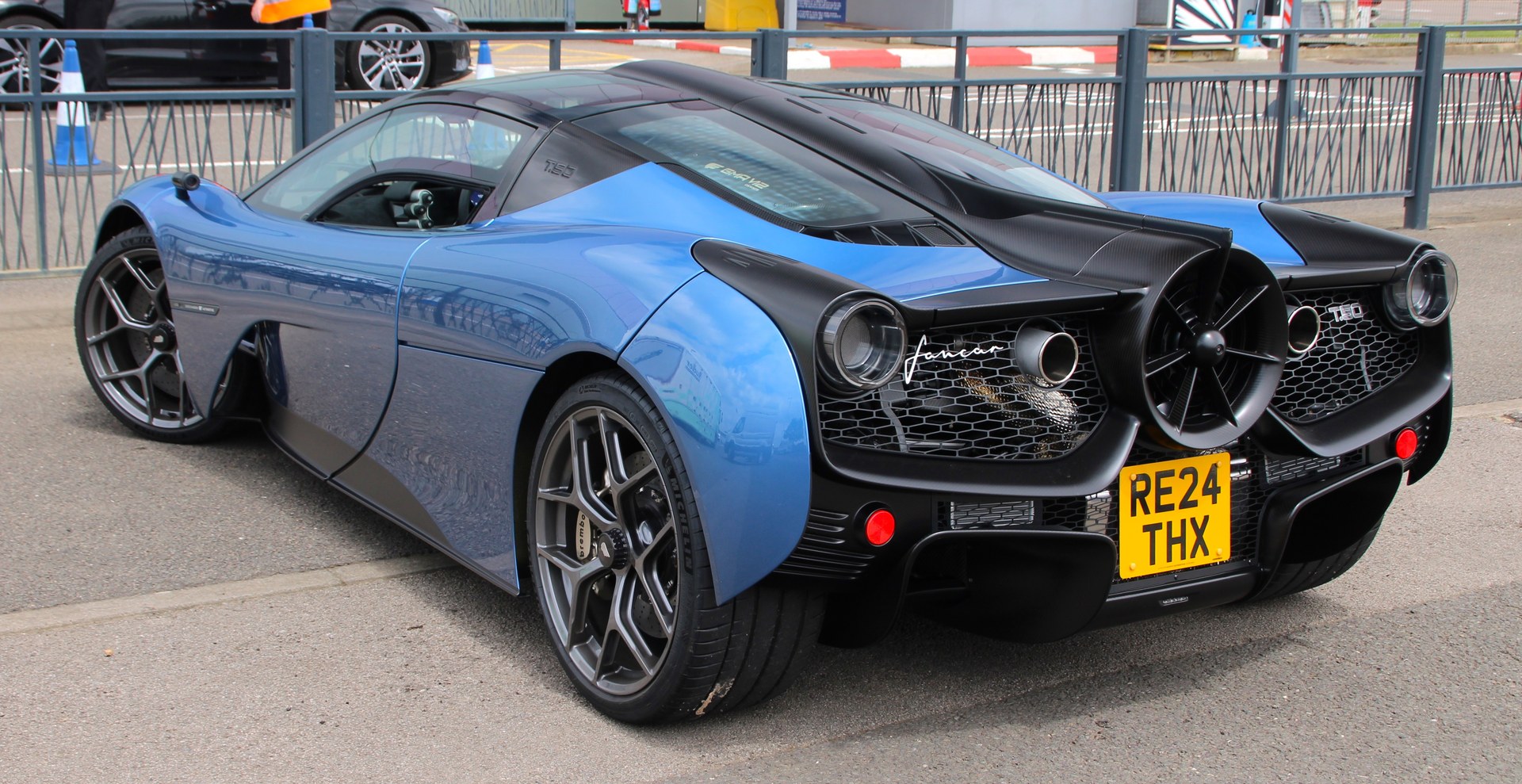
The T.50's design makes the opposite journey to the same destination. Where the Amalfi achieves cleanliness by restraint, the T.50 achieves it by technology: a patented 400 mm rear-mounted fan, derived from Gordon Murray's 1978 Brabham BT46B Formula One car, manages airflow above and below the car so that the bodywork can remain free of wings and aggressive ducts. Six aero modes adjust the balance of downforce and drag. The design is significant because the form follows a genuine aerodynamic idea rather than styling convention; the car looks the way it does because the fan allows it to.
The GT3 and the Vanquish represent the two poles of contemporary performance design. The GT3's fixed rear wing and aero-profiled suspension arms are function made visible, while the Vanquish's carbon fibre body panels and sculpted volumes pursue presence. Neither approach is inherently more significant; what matters is whether the design serves the car's stated purpose, and both manufacturers publish aerodynamic and structural justifications for their choices.
Innovation: ideas that change the conversation
A car becomes significant when it introduces an idea other manufacturers must answer. The T.50's fan-assisted ground effect is the clearest such idea in this group. Murray's Brabham fan car won its only Formula One race in 1978 before being withdrawn; applying the concept to a road car, with active management across multiple aero modes, is a genuine innovation in production-car aerodynamics, documented in GMA's technical specification.
The Amalfi's innovation is quieter but real: the integration of an active rear spoiler with three preset positions as standard equipment on an entry-level grand tourer, working in concert with brake-by-wire ABS Evo software and the SSC 6.1 vehicle dynamics system. None of these technologies is new in isolation; their significance lies in their migration down the range to a car priced at 240,000 euros in Europe.
The GT3's innovation, if the word applies, is negative: the documented preservation of a 9,000-rpm naturally aspirated engine through a generation of emissions regulation that has ended most of its peers. Innovation need not mean novelty. Sometimes it means engineering around an obstacle everyone else surrendered to.
Craftsmanship: the human content
Significance accumulates where human labour is visible. GMA documents a personalised fitting process for every T.50 owner: seat, steering wheel, and pedals are fitted to the individual, so that the central driving position is ergonomically exact. The central seat itself, flanked by two passenger seats as in the McLaren F1, is a craft decision as much as a packaging one; it declares that the driver's position is the car's reason for existing.
The Vanquish 25, unveiled by Aston Martin on 22 July 2026 to mark 25 years of the Vanquish nameplate, shows craftsmanship as commemoration. Built by Q by Aston Martin and limited to 50 cars (25 coupes, 25 Volantes), it carries Q Skye Silver paintwork, metal-foil detailing, bespoke script graphics, and laser-etched trim inlays. The mechanical package is unchanged from the standard car; the significance is entirely in the human work applied to it.
Ferrari's craft content in the Amalfi is visible in the details the company chose to revise: the return of physical buttons to the steering wheel, the 1.3 kg saved in the camshafts, the proportional bypass valve for the exhaust note. These are small decisions, but craftsmanship is a ledger of small decisions, and the technical sheet records them.
Rarity: the arithmetic of desire
Rarity is the most straightforward criterion and the most easily misunderstood. The T.50 is limited to 100 customer cars at 2.36 million pounds before local taxes, and GMA's allocation sold out within 48 hours of the car's global premiere. The track-only T.50s Niki Lauda is limited to 25 cars at 3.1 million pounds before taxes, with all 25 scheduled for completion by mid-2026. The Vanquish 25 is limited to 50 cars. These are published production caps, and they matter because they are commitments: the manufacturer is stating, in advance, that it will not meet demand.
But rarity alone does not confer significance. Limited production is a necessary condition for collectibility, not a sufficient one. What converts rarity into significance is the combination of rarity with the other criteria in this essay. A limited car with unremarkable engineering is merely scarce. The T.50's 100 units matter because of what those units contain.
Provenance and cultural significance: the story the car carries
Some cars inherit significance from their lineage. The T.50 is described by GMA as the spiritual successor to the Murray-designed McLaren F1 of 1992 to 1998, and the connection is structural, not merely rhetorical: central driving position, three seats, manual gearbox, V12, fan-assisted aerodynamics. The F1's own significance is documented in the auction record. In August 2021, Gooding & Company's Pebble Beach auction sold a 1995 McLaren F1, chassis 029, finished in the one-off Creighton Brown, with 387 kilometres recorded, for $20.465 million, a record for the model at the time. That figure is a fact about the market, not a judgement about the car, but it records the cultural weight the F1 carries, and the T.50 inherits that weight by design.
The Vanquish carries its own documented cultural history. The original car debuted at the 2001 Geneva Motor Show as an Ian Callum design succeeding the Virage, and it became the first Aston Martin driven by James Bond on screen after the character's brief run in BMWs in the 1990s films. The 2026 Vanquish 25 anniversary edition, unveiled in July and shown in person at Monterey Car Week (10 to 16 August 2026), is explicitly a celebration of that lineage. Cultural significance of this kind cannot be engineered in a single generation; it accrues, and the manufacturer's acknowledgement of it is itself a statement.
The Amalfi has no such lineage to draw on beyond the Roma it replaces, and that is worth stating plainly. Its significance, if it achieves any, will have to be earned by the car itself rather than inherited.
The driving experience: what can be said without driving
This is the criterion this essay must treat with the most discipline, because ROAD & MOTOR has driven none of these cars. What can be said is limited to what manufacturers and their engineers have placed on the record.
Gordon Murray's stated mission for the T.50 is "Driving perfection", and the company's published ethos lists three principles: exclusivity (no more than 100 of each model or variant), driving perfection (the most driver-focused cars in their sector), and lightweight (optimum performance through obsessive weight reduction). Murray's published statement at the car's reveal reads: "From the first touch of the titanium throttle pedal to the V12 screaming at 12,100rpm, the driver experience will surpass any supercar ever built. No other road car can deliver the package of power, instant responsiveness and driver feedback in such a direct and focused way while remaining comfortable, refined and usable every day." That is a claim, not a verified fact, and it is presented here as the manufacturer's stated intent.
Of the track-only T.50s, Murray has said: "This car was never about setting lap times. We simply designed the lightest, optimally-powered, most driver-centric track car possible, with the right formula, speed comes naturally." The sentence is revealing because it disavows the very metric, the lap time, by which such cars are usually judged. Whether the car delivers on the disavowal is a matter for instrumented testing, which this essay does not claim to have conducted.
Ferrari's published claims for the Amalfi are more modest and therefore more testable: steering with grip estimation described as 10 percent faster than before, brake-by-wire integration across all Manettino positions, and the active spoiler's contribution to high-speed stability. Galliera's framing, "less extreme but equally fun," sets an expectation the car can plausibly meet. The GT3's case rests on continuity: the same 9,000-rpm ceiling, the same choice of six-speed manual or seven-speed PDK, refined rather than reinvented.
Collectibility: the market as a lagging indicator
The collector market does not confer significance; it recognises it, usually late. The F1's $20.465 million result in 2021 is the clearest available evidence of the principle. The car had been out of production for more than two decades, and the market's verdict reflected engineering (the naturally aspirated V12, the central seat), rarity (64 road cars to original specification out of 106 built), provenance (Murray, McLaren, the 1995 Le Mans victory of the F1 GTR), and cultural weight, compounded over time.
Early secondary-market evidence for the T.50 exists: press reporting in 2026 notes a chassis 009 example changing hands at $8.035 million in April 2023 and a delivery-mileage chassis 035 at $5.63 million in Abu Dhabi. These are reported transactions, not valuations, and they are cited here only as evidence that the market is paying attention, not as any statement about future value. This publication does not present automobiles as investments, and nothing in this essay should be read as guidance on purchasing.
A provisional verdict
Significance, on the evidence assembled here, is a compound of at least nine elements: engineering intent, design coherence, genuine innovation, visible craftsmanship, committed rarity, inherited provenance, cultural resonance, a driving experience the manufacturer can articulate, and the market's eventual recognition. No single element suffices. The fastest car of any given year is rarely the most significant car of its decade.
Of the four reference points, the T.50 makes the most complete case on paper: documented engineering extremity, a genuine aerodynamic innovation, committed rarity, direct lineage to one of the most significant cars ever built, and a stated philosophy of driving perfection that its specification sheet supports. The GT3 makes the narrowest and perhaps the most admirable case: the preservation, against regulatory pressure, of a specific mechanical experience, repeated across a quarter century of the nameplate. The Vanquish makes the institutional case: the flagship as a statement of what a company believes about itself, renewed across three generations and now commemorated in a 50-car anniversary edition. The Amalfi makes the quietest case: a well-engineered evolution of a successful formula, honestly positioned, whose significance is still to be determined.
The numbers will be rewritten next year. The criteria will not.
Sources
- srnnews.com
- tampa.ferraridealers.com
- static.auto.co.il
- carmagazine.co.uk
- thearsenale.com
- autobuzz.my
- dailycarblog.com
- gordon-murray-automotive-p2.cdn.prismic.io
- automotiveworld.com
- thrustzone.com
- motoringresearch.com
- carsite.co.za
- en.wikipedia.org
- sportscardigest.com
- car-revs-daily.com
- stuttcars.com
- carbuzz.com
- autoevolution.com
- bytepith.com
- media.astonmartin.com
- mikeshouts.com
- carscoops.com
- racer.com