Ferrari Amalfi: the numbers behind Maranello's new front-engine grand tourer
Ferrari's Roma successor keeps the front-engine V8 formula and sharpens it on paper: 640 cv, 3.3 seconds to 100 km/h, and a claimed 1,470 kg dry weight. Here is the specification analysis, claim by claim.
Why it matters
On 1 July 2025, Ferrari unveiled the Amalfi as the successor to the 2019 Roma, its entry-level grand tourer. Ferrari states that the car is purely combustion-powered, a decision of real note at a moment when the rest of the industry is hybridising or electrifying its line-up. The company confirmed a European starting price of 240,000 euros, with first deliveries in Europe scheduled for the first quarter of 2026 and United States deliveries three to six months later at a higher, tariff-adjusted price, according to Reuters reporting from the launch.
Ferrari states that the car is purely combustion-powered, a decision of real note at a moment when the rest of the industry is hybridising or electrifying its line-up.
In Ferrari's own positioning, the Amalfi is a sports car with, in the words of chief marketing and commercial officer Enrico Galliera, a "very elegant soul". It is aimed at drivers who want, as Galliera put it, "a different driving experience, less extreme but equally fun, suitable for a wide range of driving conditions". The name references the Amalfi Coast, and the launch colour, Verde Costiera, carries the same coastal reference. ROAD & MOTOR has not driven the car, so what follows is a specification analysis based entirely on figures published by Ferrari and its dealer network.
The engine, on paper
Ferrari states the Amalfi uses an evolved version of the F154 twin-turbocharged V8, the engine family that has powered Ferrari's front-engine V8 grand tourers since the California T. Displacement is 3,855 cc from a bore and stroke of 86.5 by 82 mm. Maximum power is 640 cv at 7,500 rpm and maximum torque is 760 Nm between 3,000 and 5,750 rpm. Maximum revs are quoted at 7,600 rpm with a compression ratio of 9.4 to 1, yielding a specific output of 166 cv per litre.
The evolution over the Roma's version of the same engine family is documented in some detail. Ferrari cites a new engine control unit derived from the 296 GTB, a lighter engine block, lighter camshafts (a claimed 1.3 kg saving), turbocharger management that allows independent control of each turbine, and turbochargers that spin at up to 171,000 rpm. These are engineering inputs; their effect on response can only be judged from behind the wheel, and Ferrari makes no measured claim for throttle response in its technical sheet.
The headline performance figures Ferrari publishes are: 0 to 100 km/h in 3.3 seconds, 0 to 200 km/h in 9.0 seconds, and a top speed of 320 km/h. The dry weight to power ratio is quoted as 2.29 kg per cv. The 3.3-second claim matches that of cars positioned well above the Amalfi's price bracket, and it is achieved with a quoted dry weight of 1,470 kg, with the asterisk that the figure applies with optional lightweight content specified.
Chassis and electronics
The transmission is an 8-speed dual-clutch F1 DCT, and Ferrari says its electronic management has been revised for precision alongside closer integration with the engine software. The brake system is a brake-by-wire arrangement derived from the 296 GTB and the 12Cilindri, governed by the ABS Evo controller. Electronic controls listed in the technical specification include the Side Slip Control 6.1 system, FDE 2.0, and SCM-E Frs magnetorheological damping, with ABS Evo active in all Manettino positions.
Braking performance is stated as 30.8 metres from 100 km/h to standstill and 119.5 metres from 200 km/h. The 200 to 0 figure is a number manufacturers rarely publish, and its inclusion signals that Ferrari wants stopping power discussed as part of the car's performance envelope rather than as an afterthought. Weight distribution is quoted at an even 50 percent front to 50 percent rear, with a 50 to 50 split that on paper suits the grand touring brief.
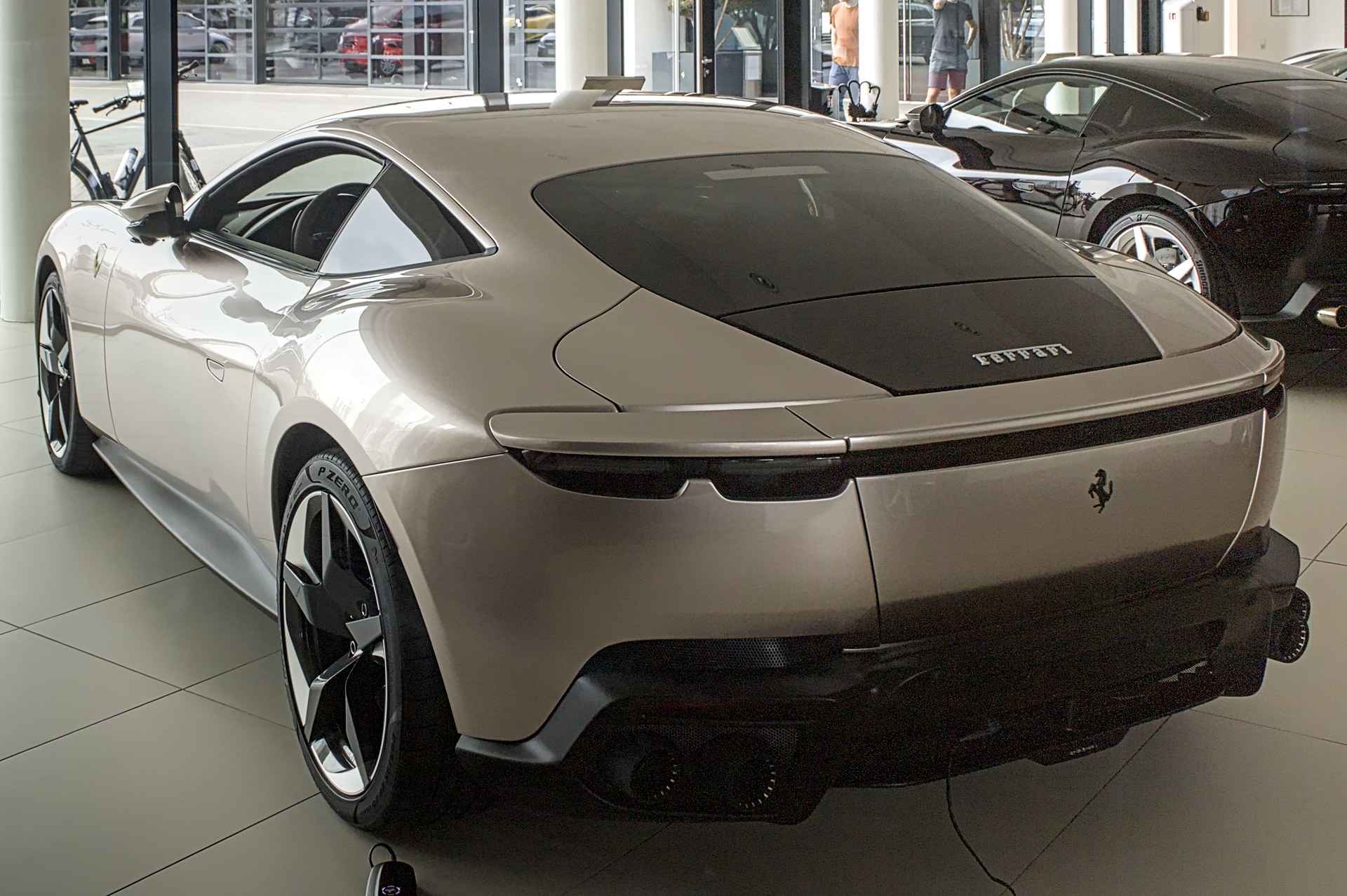
Aerodynamics are handled by an integrated active rear spoiler with three preset positions. Ferrari's dealer technical sheets describe it as rear-integrated active aerodynamics; automotive press reporting at launch adds that in its most aggressive configuration it contributes an additional 110 kg of downforce at 250 km/h (155 mph), with a 20 mm nolder on the wing to recompress airflow in the low-drag setting. The spoiler is standard equipment, not an option.
Dimensions and packaging
The Amalfi's dimensions are published as 4,660 mm long, 1,974 mm wide, 1,301 mm high, on a 2,670 mm wheelbase, with front and rear tracks of 1,652 and 1,679 mm respectively. The 2+ seating configuration carries over from the Roma, as does the generous (by the class's standards) 273-litre boot and the 80-litre fuel tank. Wheels are 20-inch forged alloys wearing 245/35 R20 tyres at the front and 285/35 R20 at the rear; carbon ceramic brakes measure 390 mm at the front and 360 mm at the rear.
Inside, the cabin layout represents a course correction that merits attention. The 15.6-inch digital instrument cluster sits ahead of a new steering wheel that restores physical buttons, including the prominent start button, answering one of the most consistent criticisms of the Roma-era interior. A central infotainment display is complemented by an 8.8-inch passenger display. Ferrari also offers a front-axle lift system that raises the nose by up to 40 mm at speeds of up to 35 km/h.
Design
Ferrari's design team, under Flavio Manzoni, states that every exterior panel is new, even though the platform, wheelbase, and glasshouse are shared with the Roma. The intent, as described by the design office, is a clean, monolithic form with a minimum of fiddly detail. The most visible changes are at the front: sharper headlight graphics and a simplified grille treatment that moves away from the Roma's more anthropomorphic face. The long, contoured bonnet remains the car's defining proportion, as it should be in a front-mid-engine grand tourer.
The restraint of the surfacing is deliberate. Where Ferrari's recent mid-engine cars have carried intricate technical surfaces and layered aerodynamic furniture, the Amalfi presents largely uninterrupted volumes. The active spoiler integrates flush into the rear bodywork when stowed, which means the aero function is only visible when deployed. This is a car designed to look serene at rest and to change character only when its systems demand it.
Where it sits
The Amalfi is the latest entry in Ferrari's front-engine V8 grand tourer lineage, which in modern form runs through the California (2008), the Portofino (2017), and the Roma (2019). Each generation has paired a twin-turbocharged V8 with a 2+ cabin and a remit of daily usability alongside performance figures that would once have defined the supercar category. The Amalfi continues that pattern while removing the last hybrid hardware from the equation at this level of the range: no electric motor, no battery, no plug.
It also arrives at a documented inflection point for the company. Ferrari unveiled the Amalfi just months before beginning the staged reveal of its first fully electric model, and Reuters reported the company cautioning that a second, higher-volume EV would not arrive before 2028. In that context, the Amalfi reads as Ferrari's statement that combustion grand touring still has a defined, defended place in the range.
Who it is for
On paper, the Amalfi is for the buyer who wants Ferrari performance figures (3.3 seconds, 320 km/h) in a car with rear seats, a 273-litre boot, and a design language calibrated for elegance rather than aggression. Ferrari's own framing, "less extreme but equally fun," describes the positioning precisely. The 240,000-euro European entry price puts it at the accessible end of the Ferrari range, and the seven-year maintenance programme Ferrari offers applies as it does across the line-up.
What cannot be known from specifications is whether the evolved V8, the revised gearbox logic, and the new brake-by-wire system deliver the immediacy and refinement the figures promise. Those are driving questions, and this analysis makes no claim on them. On paper, the Amalfi is a coherent, numbers-strong evolution of a successful formula. The rest awaits the road.
Sources
- srnnews.com
- tampa.ferraridealers.com
- static.auto.co.il
- carmagazine.co.uk
- thearsenale.com
- autobuzz.my
- dailycarblog.com
- gordon-murray-automotive-p2.cdn.prismic.io
- automotiveworld.com
- thrustzone.com
- motoringresearch.com
- carsite.co.za
- en.wikipedia.org
- sportscardigest.com
- car-revs-daily.com
- stuttcars.com
- carbuzz.com
- autoevolution.com
- bytepith.com
- mikeshouts.com
- carscoops.com
- racer.com