The Architecture of a Great Driving Position
Seat, pedals, sight lines and steering: how a small number of cars got the driver-machine interface right, and what the rest can learn.
Every car is designed from the driver's seat outward, or it should be. The driving position is the one part of a car's architecture the driver never stops using: it determines what can be seen, how precisely the controls can be worked, and how long concentration lasts. A small number of cars have treated it as the central design problem rather than a packaging afterthought. Their solutions repay study.
Every car is designed from the driver's seat outward, or it should be.
The seat is the first instrument
The hip point, the height of the driver's hips relative to the road, sets the terms of everything else. Sit low and the car feels keyed to the road surface; the sense of speed, the reading of camber and the connection to the chassis all sharpen. Sit high and the driver commands a view but loses intimacy with what the car is doing.
Porsche has made the low seat a generational constant. In the words of its own newsroom, "for generations, the Porsche 911 has been characterised by the low seating position typical to a sports car," paired with what the company calls a clear, efficient operating logic. The 911's cockpit groups its important controls directly on or around the steering wheel under the Porsche Driver Experience concept, so that the driver's hands rarely need to leave the rim. It is a philosophy of reduction: the seat places the driver low, and everything else is arranged within the arc of that position.
The case for the centre
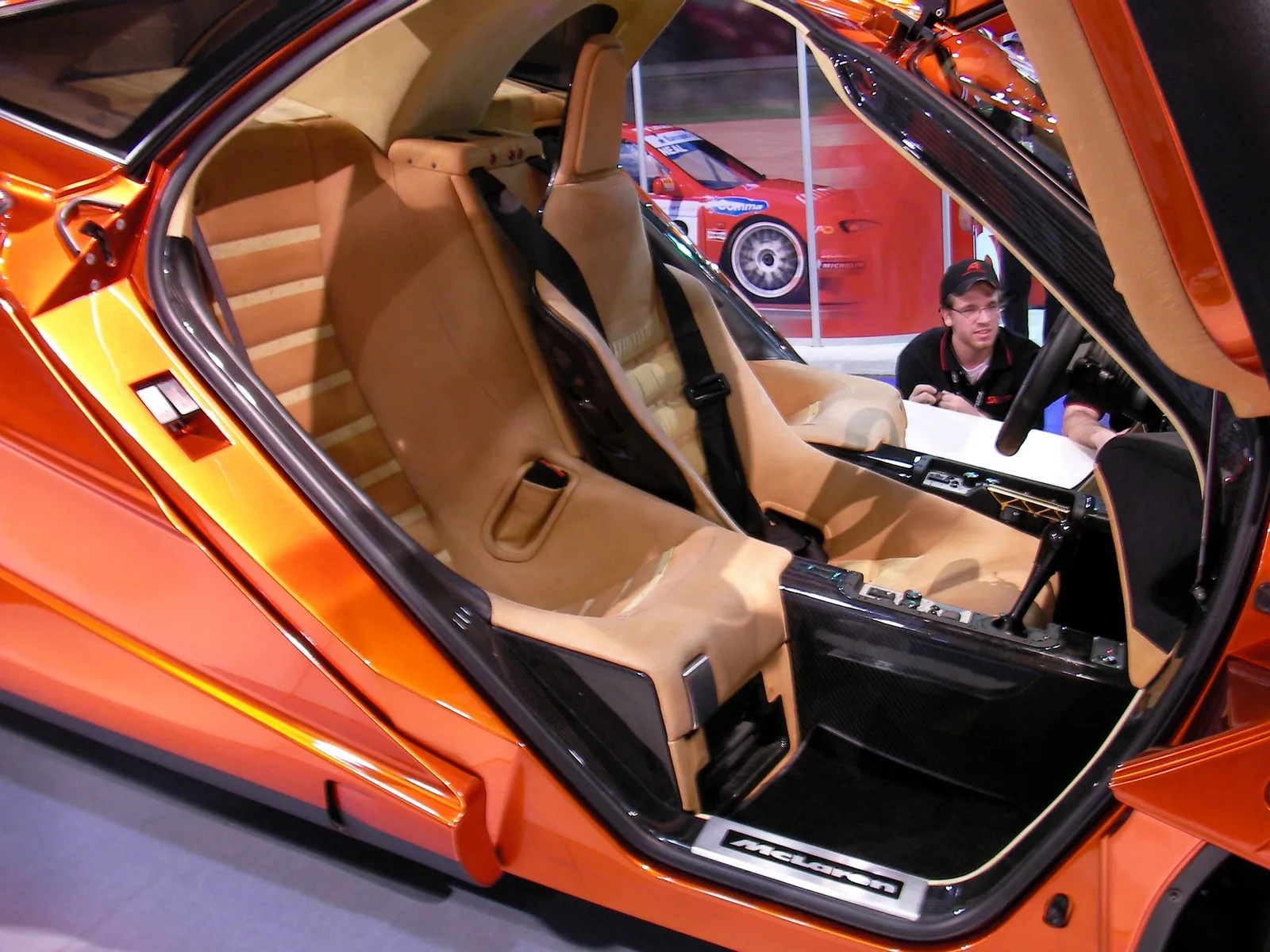
The most radical answer to the driving position question was given in 1992, when the McLaren F1 placed the driver in the centre of the car, flanked by two passengers set slightly behind. Designed by Gordon Murray, the F1's three-abreast layout was not a novelty. It put the driver's weight on the car's centreline, like a single-seater racing car, and it gave perfectly symmetrical sight lines: no A-pillar bias, no offset judgment of the car's extremities. The car was built around a carbon-fibre monocoque, powered by the BMW S70/2, a 6.1-litre naturally aspirated V12, and 106 examples were built between 1992 and 1998.
Murray returned to the layout nearly three decades later with the Gordon Murray Automotive T.50, unveiled in 2020. The T.50 seats its driver centrally in what the company describes as a jet-fighter-style position, with the two passengers again set back on either side. The case for the centre is ergonomic as much as symbolic: with the driver on the centreline, pedal placement, steering column angle and sight lines can all be made symmetrical, and the driver judges the car's width with equal reference points on both sides. McLaren itself later revived the layout for the Speedtail, its 106-unit hybrid hyper-GT, which suggests the idea has outlived its era.
Pedals and the working feet
Pedal placement is the least glamorous and most consequential part of the driving position. The pedals must fall under the feet without the driver reaching, the spacing must allow heel-and-toe work in a manual car without inviting the wrong pedal in an emergency, and the pedal faces must offer consistent grip in all weathers.
The T.50 treats this as bespoke work. Each customer goes through a fitting session in which the driver's seat, steering wheel and pedals are adjusted to be, in the company's phrase, ergonomically perfect and individualised. The three pedals are machined from solid aluminium, chosen for light weight, grip and feedback, and the car keeps a six-speed manual gearbox from Xtrac rather than paddles. The message is that the interface between foot and machine deserves the same engineering attention as the interface between tyre and road. In lesser cars the pedal box is a packaging compromise, offset to clear the wheel arch; in the best ones it is designed around the driver's legs first.
Sight lines and the driver's axis
What the driver sees, and when, is a design decision. Porsche's cockpit doctrine holds that the instrument cluster should be the highest point on the dashboard, with the rev counter at its centre: in the current 911, a fully digital curved display offers a Classic view with five round dials and a central rev counter whose scale rotates so the needle sits at twelve o'clock at shift speed, a direct inheritance from the company's racing cars. The principle is that the eye should travel the shortest possible distance between road and information.
The central-seat cars take this further by removing asymmetry from the view itself. In a conventional left- or right-hand-drive car, the driver sits closer to one A-pillar and judges the far corner of the car across the cabin. Centred, the sight lines down both flanks are equal, and the windscreen pillars frame the view symmetrically. It is a small advantage measured in centimetres of judgment, and it is exactly the kind of advantage that matters at the limit.
Steering geometry
Steering feel begins with geometry: where the rack sits, the angle of the column, the ratio, and how much assistance intervenes. The T.50 is instructive here for what it leaves out. Its steering is power-assisted only at low speed; above parking manoeuvres the driver is connected directly to the front axle. That choice reflects a belief that assistance should solve the problem of manoeuvring weight and then get out of the way, rather than filtering every input through software.
The broader lesson is that the steering wheel's position relative to the seat determines arm geometry, and arm geometry determines precision. A wheel too far away forces straight arms and shoulder steering; a wheel too close crowds the driver and shortens leverage. The correct position, with elbows slightly bent and hands able to reach the full rim without shifting in the seat, is the same whether the car costs as much as a house or as much as a motorcycle. It is simply rarer to find it designed in from the start.
The interface: controls within reach
The final layer is the secondary controls: the switches, dials and screens that the driver operates without looking. The T.50's cabin uses aerospace-grade aluminium rotary switches and a floating arm beside the driver carrying a titanium gear lever, with a centred instrument cluster dominated by a large tachometer. The design logic is consistent with the Porsche doctrine: primary information ahead of the eyes, primary controls at the fingertips, everything else arranged in an ergonomic bubble around the seated driver.
The trend in the wider industry runs the other way, toward screens that demand the eye and menus that demand attention. The cars studied here argue the opposite: that the best interface is the one the driver forgets, because every control falls where the hand expects it.
What the three agree on
The McLaren F1, the T.50 and the 911 approach the driving position from different directions: the radical centre, the bespoke centre, and the evolved conventional seat. They agree on the fundamentals. The driver sits low. The controls are arranged around the driver's body, not the packaging department's convenience. The instruments prioritise the rev counter and minimise eye travel. And the steering connects the driver to the road with as little mediation as the car's purpose allows.
A great driving position cannot be specified from a brochure, but it can be recognised in minutes: the seat supports without constraining, the pedals fall under the feet, the wheel is where the hands expect it, and the road ahead is framed, not obstructed. Everything else in car design is commentary.