The Ferrari F80, One Year In: Maranello's V6 Flagship Finds Its Feet
First customer cars arrived in December 2025, and the F80 is now in owners' hands on both sides of the Atlantic. It is the fastest road car Ferrari has ever built, and the most argued-over.
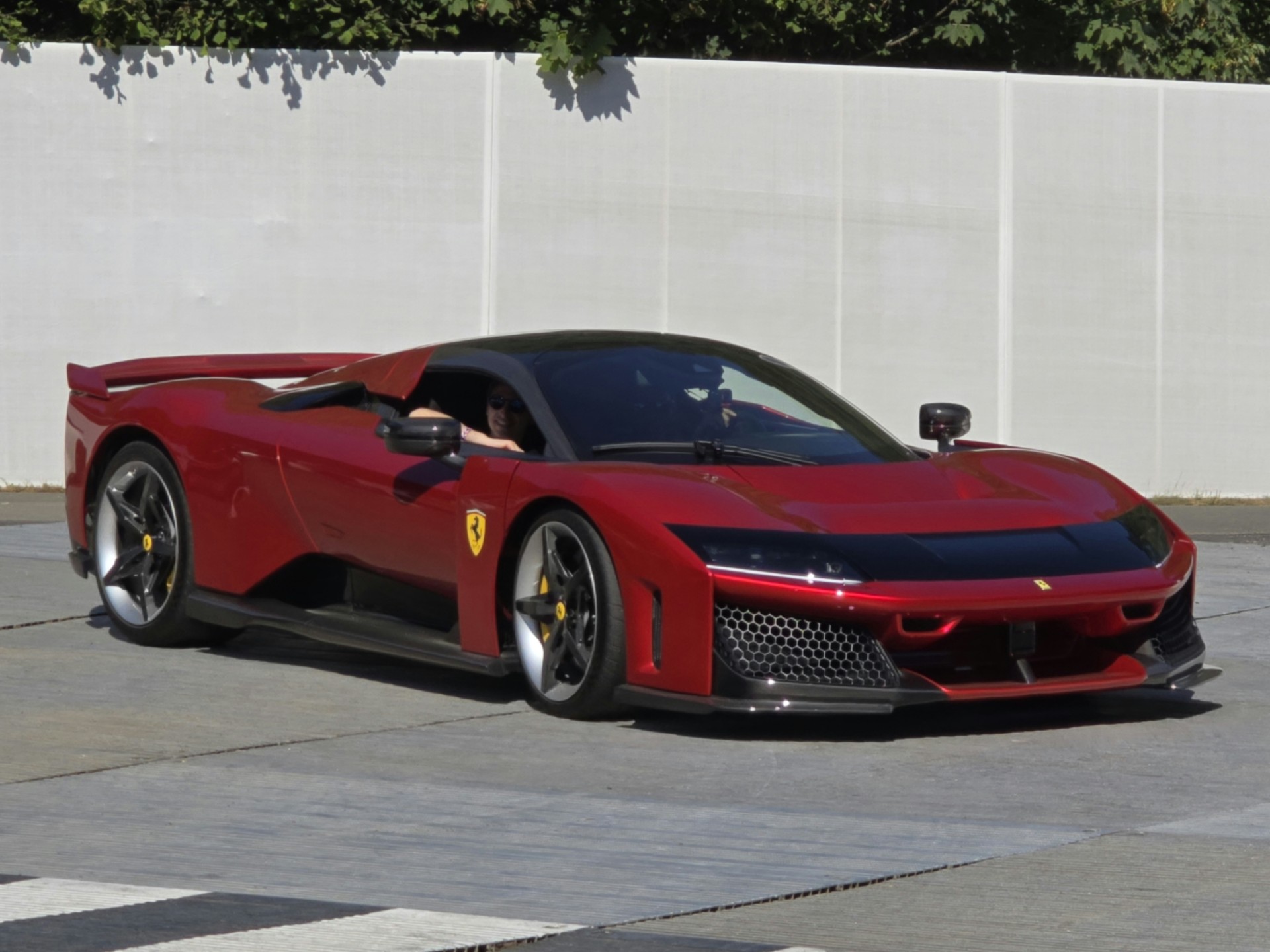
The Ferrari F80 arrived in October 2024 carrying a difficult brief: succeed the LaFerrari as the definitive Maranello flagship while replacing a V12 with a V6. Two years on, the numbers have landed, the first reviews are published, and customer cars, 799 of them, are being delivered. The argument about the engine has not ended. The car's credentials, on paper and at Fiorano, are now impossible to dismiss.
The F80 is not an electrified car chasing efficiency figures. It is a combustion car using electricity the way a turbocharger uses exhaust gas: as a tool for making the engine work better.
Why a V6: the engineering case
The F163 CF is a 120-degree, 3.0-litre twin-turbo V6 with a dry sump, producing 900 cv (888 bhp) at 8,750 rpm and 850 Nm at 5,550 rpm. That is roughly 300 cv per litre from the combustion engine alone. The turbos are electrically assisted, a first for a Ferrari road car, which addresses the lag that normally accompanies high-boost turbocharging: the electric motors spool the turbos before exhaust gas takes over.
The choice is deliberate, not a downsizing exercise. A 120-degree V6 is wide, short and stiff, with a low centre of gravity, and its architecture descends directly from Ferrari's Le Mans and Formula One experience. Ferrari's argument is that cylinder count is a proxy for something else, mechanical sophistication, and that the F80's six are more sophisticated than any twelve the company has built.
The hybrid system: electric, but not a plug-in
Three electric motors support the V6: two 105 kW units on the front axle providing electric all-wheel drive, and a 60 kW MGU-K at the rear assisting the crankshaft. A 2.28 kWh 800V battery feeds them. Total system output is 1,200 cv (1,184 hp). There is no plug-in charging and no pure electric driving mode. The hybridisation exists for one purpose: performance, through torque fill, traction and energy recovery. An eight-speed F1 dual-clutch transmission handles the gears.
This matters for how the car should be understood. The F80 is not an electrified car chasing efficiency figures. It is a combustion car using electricity the way a turbocharger uses exhaust gas: as a tool for making the engine work better.
The performance, documented
Ferrari claims 2.15 seconds to 100 km/h and 5.75 seconds to 200 km/h, with a 350 km/h top speed. Dry weight is 1,525 kg in its lightest configuration. The headline that carries most weight in Maranello is the Fiorano lap: 1 minute 11.5 seconds, the fastest time ever set by a Ferrari road car at the company's own circuit, more than eight seconds quicker than the LaFerrari. First reviews, including Evo's in August 2025 and Autocar's, tested the car at Misano and on the road.
Deliveries: the real story of 2026
The F80's 2026 story is a delivery story. Ferrari handed over the first customer cars in December 2025. A US-spec car was documented in the spring of 2026, and the first American customer car, a Verde GB23 example, appeared publicly at the Concorso Ferrari in Pasadena in May 2026. All 799 units were sold at the reveal, with pricing reported around €3.6 million and US figures quoted in the $3.7-3.9 million range.
In 2026, analysts flagged a slower-than-expected delivery ramp: HSBC cut its 2026 F80 estimate from 225 to 155 units in January, and Ferrari later acknowledged deliberately pacing deliveries, describing F80 shipments as being in the ramp-up phase in line with plans. Ferrari appears to be smoothing revenue across years rather than rushing cars out, a strategy that also protects exclusivity while the order book is full.
The analysis: what the F80 actually proves
The F80 will be debated for years, and the V6 will remain the hinge of every argument. But the car's real statement is structural. Ferrari has shown that its flagship formula, extreme aerodynamics, motorsport-derived hybridisation and ruthless weight discipline, can survive the end of the big-cylinder era. The e-turbo V6 is the most interesting part of the car, not the compromise some feared.
The McLaren W1, its natural rival, makes 1,258 hp from a twin-turbo V8 hybrid and had its first media drives in mid-2026, but has no documented customer deliveries as of September 2026. Ferrari, by getting cars to owners first, has seized the initiative in the flagship conversation. The F80's success will ultimately be judged the way every Ferrari flagship is judged: not by the spec sheet, but by whether, a decade from now, it is spoken of in the same breath as the F40, the F50, the Enzo and the LaFerrari. On the evidence so far, it has earned the right to be in the discussion.


