The 75th Pebble Beach Concours: A Duesenberg, a Farewell, and the State of the Art
The Clark Gable SSJ took Best of Show at a landmark edition that also marked the end of Sandra Button's 40-year chairmanship. Notes on what the concours is becoming.
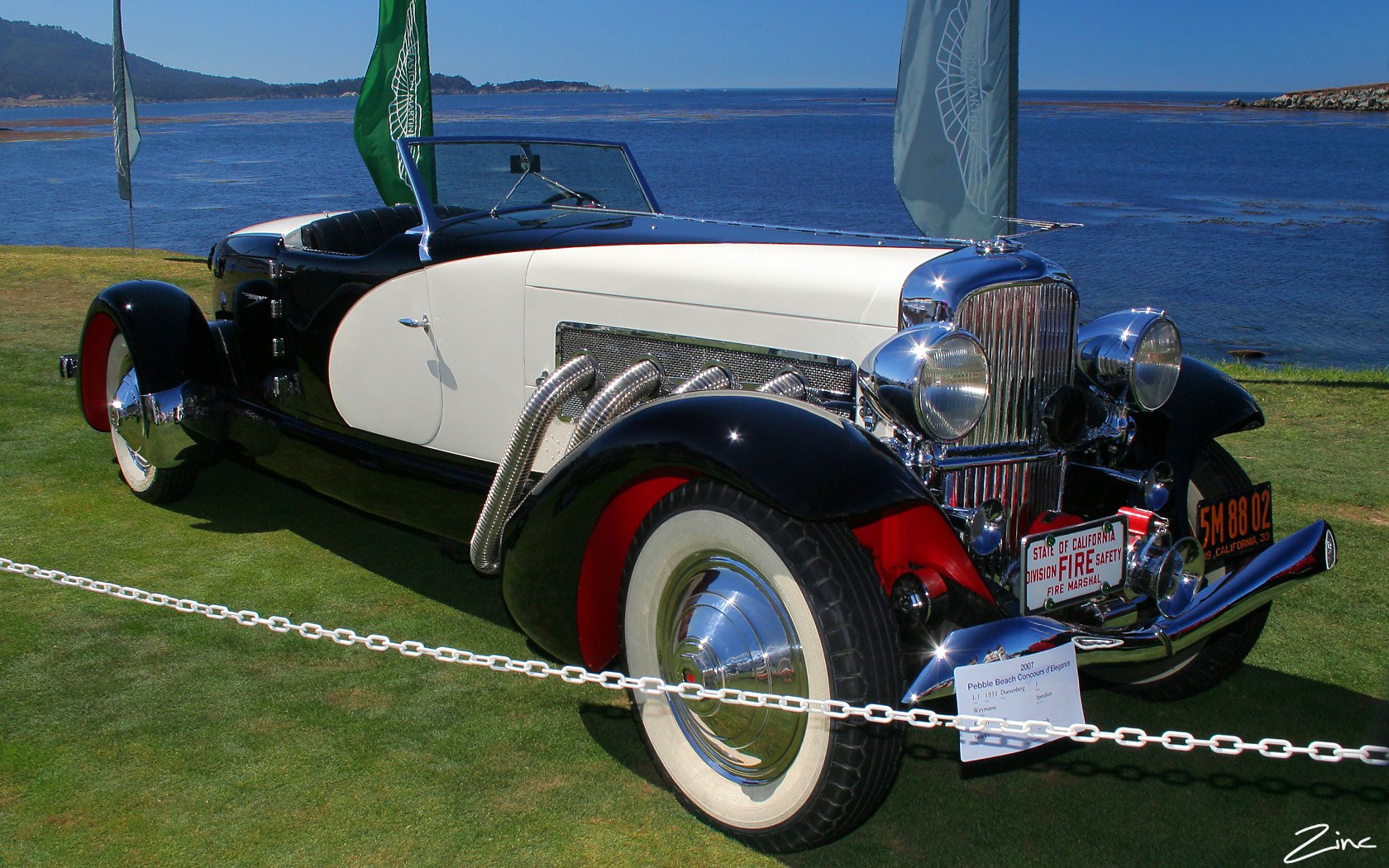
The 75th Pebble Beach Concours d'Elegance, held August 16 on the 18th fairway of Pebble Beach Golf Links, did what the concours has always done and did one thing it had never done. It named a worthy Best of Show, the 1935 Duesenberg SSJ Special Speedster shown by Harry Yeaggy of Cincinnati, Ohio. And it closed the 40-year chairmanship of Sandra Button, who presented the top award for the final time before handing the event to Vince Finaldi.
The direction of travel is clear: the concours is increasingly rewarding cars with real histories, honestly presented, over cars with the shiniest paint.
The winning car needs little introduction to readers of this publication. It is one of two SSJ Special Speedsters Duesenberg built, the short-chassis, supercharged ultimate expression of the Model J, designed by Herb Newport with a supercharged straight-eight of close to 400 horsepower. This car was the one loaned to Clark Gable; its sibling went to Gary Cooper. Owned by the Ferrara family for more than six decades, it passed to Yeaggy around 2023 and was returned to its original black lacquer over light saddle leather by Classic Restoration Services, with the engine work by Straight Eight of Troy, Michigan. Yeaggy had won Best of Show once before, in 2007, with the Mormon Meteor Duesenberg SJ Speedster. "I won once before, 19 years ago, but I appreciate it a lot better now," he said. "People don't realize how hard it is, how special it is, to win this award."
With this victory, Duesenberg has eight Best of Show trophies, making it the winningest American marque in the concours' history.
The company it kept
The nominees for Best of Show were a study in the concours' current range: a 1938 Delahaye 165 Figoni et Falaschi Cabriolet from the Pearl Collection of Baar, Switzerland; a 1955 Ferrari 375 MM Pinin Farina Berlinetta from the Heinecke Family Collection of Bangkok, Thailand; and a 1954 Ferrari 375 America Vignale Cabriolet from RQ Collections of The Woodlands, Texas. Two hundred eighteen cars took the field, including 33 international entries from 14 countries and 185 American entries from 30 states. Classes this year ran from Vignale-bodied Ferraris to Japanese motorsport icons to the cars of Royal India, a spread that would have been unthinkable at Pebble Beach a generation ago and is now simply the program.
The elegance awards reflected the same breadth. The Gwenn Graham Most Elegant Convertible went to a 1935 Duesenberg J Rollston Convertible Coupe from the Singleton Collection. The J. B. and Dorothy Nethercutt Most Elegant Closed Car went to William E. Connor's 1937 Talbot-Lago T150 C-SS Figoni et Falaschi Teardrop Coupe. The Ansel Adams Award went to a 1931 Pierce-Arrow from Mumbai. The ArtCenter College of Design Award went to a 1974 Lancia Stratos HF Stradale, which tells you something about where design culture is heading.
Button's farewell
Sandra Button's departure is the more consequential story of the day. Forty years at the helm of the world's most important concours is a tenure that cannot be replaced, only succeeded. "First of all, I'm here for the cars," she said after presenting the award for the final time. "They can't speak for themselves, and it's up to us to take care of them for the future." The concours also passed a milestone worth recording without fanfare: total charitable giving has now surpassed $50 million.
Her successor, Vince Finaldi, inherits an event facing the questions every great institution faces. The concours must recruit younger enthusiasts into a hobby whose economics have moved decisively upmarket, and it must do so without diluting the standard that makes Pebble Beach the standard. The announced themes for 2027, Delage's Grand Prix-winning season and 40 years of the Ferrari F40, suggest the programming will continue to balance the pre-war canon with the cars of living memory.
What the 75th proved
There is a lazy criticism of concours culture that it is a beauty contest for trailer queens, and like most lazy criticisms it contains a fraction of truth. But the fraction is shrinking. The SSJ is a car that was driven in period, raced in legend, and restored to evidence rather than to fantasy. The Delahaye that stood beside it in the final judging came from a collection famous for using its cars. The Stratos that won the design award is a rally car. The direction of travel is clear: the concours is increasingly rewarding cars with real histories, honestly presented, over cars with the shiniest paint.
Seventy-five years after the first concours was staged as an adjunct to the Pebble Beach Road Races, the event remains the place where the collector world's arguments get settled in public, on grass, in daylight. This year's argument was settled in favor of an American car with a supercharger, a Hollywood past, and a restoration built on two inches of original paint. It was a good argument to win.